

Improving Profit at Your Agency
- Profit & Pricing
- All insights
- Recent Thinking
- Mike Smith
Table of Contents
Improving Profit at Your Agency
If you run an agency or studio, you’ll know the feeling: the diary’s full, the team’s stretched, new projects are landing, and yet the bank balance at month-end doesn’t quite reflect all that effort. You’re not alone, and you’re not doing anything unusually wrong. Agency economics are genuinely tricky, and most founders never get taught how to manage them properly. You got into this because you’re good at the work, not because you trained as a financial controller.
At VaultHQ we work with a lot of agencies and studios, and the pattern is remarkably consistent. Revenue isn’t usually the problem. Profit is. So let’s talk about where it actually leaks out, and what improving profit really takes, practically, not theoretically.
Growth isn’t the Same as Profit
The most common trap we see is founders chasing top-line growth as a proxy for success. More clients, more retainers, more headcount to service it all. It feels like progress, and it often is progress, for your workload. But agency margins are thin and fragile by nature, and scaling a business with weak unit economics just scales the weakness.
Before growing, it’s worth understanding profitability at the level of a single client, a single project, even a single team member. Which accounts are genuinely profitable once you account for the time they actually consume, not the time you quoted? Most agencies have never properly answered this, because the accounting systems they use weren’t built to… or because they just don’t want to. General ledger software will tell you your overall margin; it won’t tell you that Client X has been quietly loss-making for eight months because of scope creep nobody logged.
Get Honest About Utilisation
Your biggest cost is people, and your biggest lever is how much of their time is spent on billable, value-generating work versus everything else: admin, internal meetings, pitching, rework, “quick favours” that never made it onto an invoice.
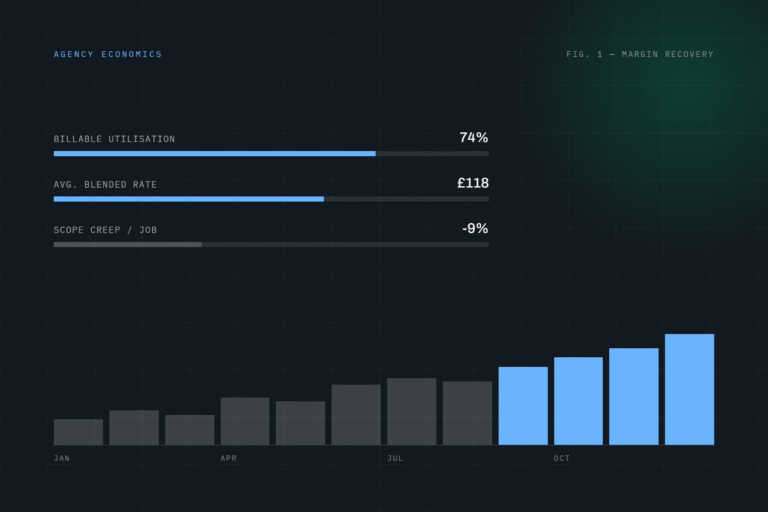
Most agency owners have a rough sense of their utilisation rate but haven’t actually measured it. Once you do, it’s often uncomfortable. A studio that thinks it’s running at 75% is frequently closer to 55-60% in reality, and that gap is where profit quietly disappears.
The fix isn’t “work harder.” It’s visibility. Time tracking gets a bad reputation in creative businesses because it feels bureaucratic and we often hear “we don’t want the team to feel like we’re BIG BROTHER”, but used well, it’s simply the data that lets you price accurately, spot scope creep before it eats a project’s margin, and have honest conversations with clients about what things really cost to deliver.
Pricing Is Where Agencies Bleed Quietly
Day rates and hourly billing feel safe because they’re easy to justify, but they cap your profit at exactly the moment your team gets more efficient. The better you get at the work, the less you earn per project, which is a strange incentive to build a business around.
Value-based and fixed-fee pricing, done properly, breaks that link. It means pricing on outcome and impact rather than hours, and it rewards efficiency instead of punishing it. This is a bigger shift than it sounds, it touches your proposals, your scoping process, your client conversations, and how confidently you talk about money. But agencies we see that make this shift consistently report healthier margins than those still selling time.
A smaller, easier win sits right underneath this: review your rates and packages at least annually. Costs rise every year, salaries, software, overheads, and if your pricing doesn’t rise with them, your margin erodes quietly, even if revenue looks stable.
Scope Creep Is the Silent Killer
Almost every unprofitable project we come across didn’t start that way. It became unprofitable through a hundred small, reasonable-sounding additions the client asked for and the account team agreed to, because saying no felt awkward or the relationship mattered more than the invoice.
The answer isn’t to become rigid with clients. It’s to build a culture where scope is written down clearly at the start, changes are flagged and priced as they happen (even if you don’t always charge for them, you should always know their cost), and account leads understand that protecting margin is part of their job, not a betrayal of client service.
Overheads Creep Too
Software subscriptions, office space, freelancer spend, that “temporary” hire from eighteen months ago, overheads accumulate quietly in a growing agency. Few founders sit down twice a year and ask, line by line, “do we still need this, and is it still worth what we’re paying?”
It’s one of the simplest profitability exercises available, and one of the most neglected, because it’s not glamorous. But a proper overhead review, done regularly, often finds more margin than some of your new business ever will.
Know Your Numbers Monthly, Not Annually
A lot of the founders we speak to only really look closely at their numbers once a year, at year-end, when the ‘traditional’ accountant sends over the accounts. By then, the profitable or unprofitable decisions have already been made, months ago, and there’s nothing left to do but note them for next time.
Profitable agencies treat their management accounts as a working tool, not an annual formality. Monthly, or at least quarterly, visibility of margin by client, utilisation, cash position and overhead trends means you catch problems while they’re still small and fixable, rather than discovering them retrospectively.
Cash Flow and Profit Are Different Problems
It’s entirely possible to be profitable on paper and still run into cash trouble, retainers that don’t quite cover delivery costs in the lean months, lumpy project payment terms, or simply invoicing too late because it fell down the priority list during a busy sprint. Agencies with strong financial discipline invoice promptly, chase payment terms firmly but professionally, and build a cash buffer for the quieter months every agency (even yours) experiences at some point.
Where VaultHQ Comes In
None of this requires a finance degree or a full-time CFO on day one. It requires the right numbers, presented clearly, reviewed regularly, and interpreted by people who understand how agencies actually work, not generic small-business advice bolted onto a creative business with a very different cost structure.
That’s what we do. We work specifically with digital agencies and creative studios to build the financial visibility that makes improving profit possible: client-level profitability, utilisation tracking, pricing strategy, management accounts that actually inform decisions, and proactive advice rather than once-a-year compliance.
Have we struck a nerve?
If you suspect your agency is more profitable on the surface than underneath, it’s worth a conversation. Book a discovery call and let’s take an honest look at where your margin is going, and what getting it back would mean for your business.
Disclaimer:
The content included in this blog post is based on our understanding of tax and company law at the time of publication. It may be subject to change without notice and may not be applicable to your circumstances, so should not be relied upon. You are responsible for complying with tax law and should seek independent advice if you require further information about the content included in this post or guide.